
What Is Answering Machine Detection (AMD)? The 2-Second Window Behind Every Outbound Dial
Federal telemarketing rules give an outbound dialer exactly two seconds. If someone picks up and no rep is connected within two seconds of that person's completed greeting, the call is legally abandoned (FTC Telemarketing Sales Rule, 16 CFR 310.4, 2024). Inside that window, software has to answer one question: is this a real person, or a recording?
That question is answering machine detection, usually shortened to AMD. This is the definitional guide: what AMD is, what signals it reads, which types exist, how accuracy gets measured, and what actually separates a false positive from a false negative. For the business case, see why AMD deserves its own line in a dialer evaluation.
Key Takeaways
- AMD classifies an answered call as a live person or a recording, then routes it.
- It reads timing, greeting length, acoustic cues and carrier signaling, not meaning.
- Published research reports 96.1% classification accuracy at 46ms inference (Saurav, arXiv, 2026).
- One accuracy number tells you nothing without speed and error direction.
What Is Answering Machine Detection (AMD)?
AMD is software that listens to the opening moments of an answered call and classifies it as a live person or a recorded greeting. It exists because most dials never reach anyone. In a study of 6,264 cold calls, 55% went unanswered and 17% hit non-working numbers (Baylor University Keller Center, 2012).
The one-sentence definition
Answering machine detection is a real-time classifier that decides whether the audio on a newly answered call comes from a person or a machine, and hands that verdict to the dialer before the rep hears anything. Everything else in AMD is an implementation detail of that one decision.
What AMD is not
AMD isn't voicemail transcription, which happens after the fact. It isn't spam labeling, which happens on the carrier side before the phone rings. It isn't call screening, and it isn't caller ID. AMD only classifies the answering party. Confusing it with those neighbours leads to the wrong evaluation questions.
Where AMD runs in the call path
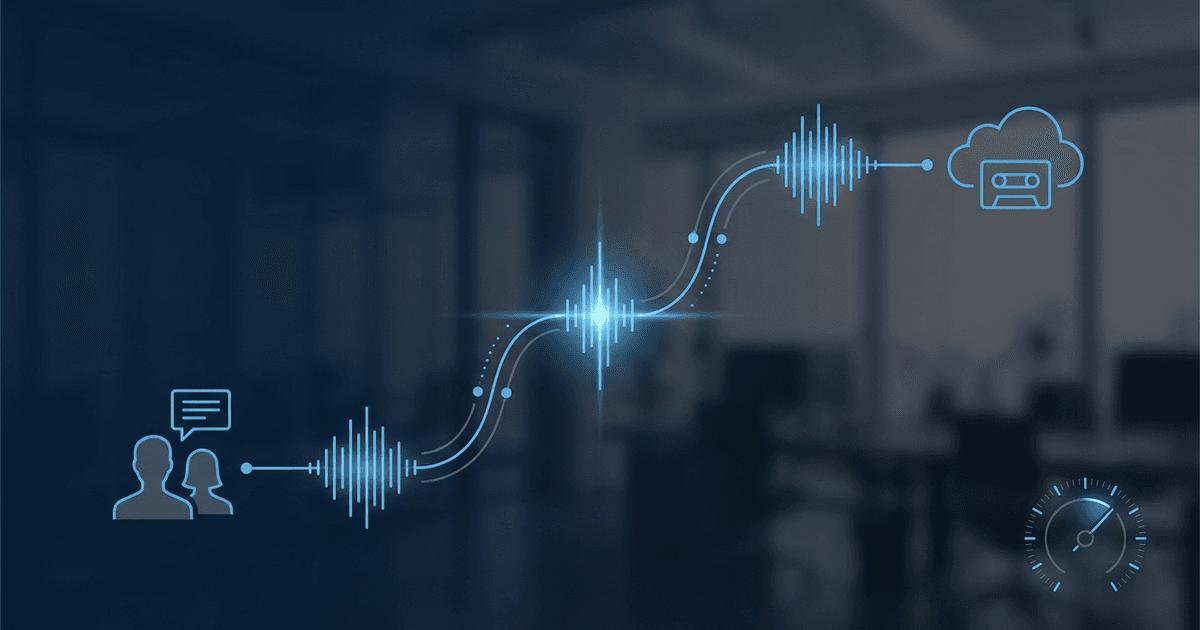
The classifier sits between the moment the carrier reports the call as answered and the moment audio is bridged to a rep. It receives a live audio stream, evaluates it continuously, and emits a verdict. Because the rep isn't on the line yet, every millisecond of analysis is silence on the prospect's end.
What AMD outputs
A good AMD returns more than a binary flag. Typical outputs include the class (person, machine, fax, or unknown), a confidence score, the elapsed time to decision, and sometimes a beep timestamp. Those extra fields are what let a dialer log an outcome rather than just drop the call.
How Does Answering Machine Detection Actually Work?
AMD converts the first few seconds of audio into features, then classifies them. One published system extracts 15 temporal features from voice-activity output and runs a small boosted tree ensemble, completing end-to-end inference in 46ms on a commodity dual-core CPU (Saurav, arXiv, 2026). The audio buffer, not the model, dominates total latency.
Signal one: silence and onset timing
The first thing a classifier measures is when speech starts. People answer and speak almost immediately after the line opens. Recordings often begin after a short mechanical pause, and that pause is consistent across calls. In the research above, the timing of the first speech onset alone carried 11% of the model's total feature importance.
Signal two: greeting length and cadence
"Hello?" runs under a second. A voicemail greeting runs seven to twenty. The single strongest predictor in the published model was the ratio of speech in the first half of the audio window, worth 54.6% of feature importance on its own. Machines talk continuously; people say two words and then wait for a reply.
Signal three: acoustic and content cues
Beyond timing, classifiers read compression artifacts from stored audio, room acoustics that differ between a live handset and a recording, and the tonal flatness of pre-recorded speech. Speech detection can also spot stock greeting phrases. These cues improve accuracy but usually need more audio, which is why they arrive later in the decision.
Signal four: carrier and network signaling
Some information never touches the audio. Carrier signaling can indicate that a call was forwarded to voicemail, that a number is disconnected, or that the call was answered by network equipment rather than a device. Signaling-based hints are the only AMD input that costs zero listening time, which makes them the cheapest tier in any detection stack.
What Are the Main Types of AMD?
There are three broad families: heuristic timing detection, model-based speech detection, and tiered hybrids that combine both. The choice determines your speed-accuracy trade-off, and it shows up directly in connect rate, which typically runs between 3% and 10% of dials to a live person (ZoomInfo, 2025).
Heuristic timing detection
The oldest approach uses hand-tuned thresholds: how long the initial silence lasted, how long the greeting ran, how much silence followed it. It's cheap, transparent, and easy to debug. It's also slow by design, because a threshold on "greeting length" can't fire until the greeting has run long enough to exceed it.
Model-based speech detection
Here a trained classifier scores the audio instead of comparing it to fixed rules. Accuracy improves, especially on unusual greetings and accented speech, and the model can emit a confidence score rather than a hard verdict. The cost is opacity: when a model misclassifies, the reason isn't visible in a config file.
Tiered hybrid detection
Modern systems layer both, escalating only when the cheap check is uncertain. Personnect publishes a five-tier model on its public speed test page, moving from pattern recognition under 100ms, through behavioural analysis around 300ms, to deeper analysis for edge cases, with a hard default to connect at six seconds. The fallback matters as much as the tiers.
Beep detection versus greeting detection
These are different jobs and get confused constantly. Greeting detection decides whether a machine answered. Beep detection finds the tone that signals recording has started, which only matters if you intend to leave a message. A dialer can be excellent at one and useless at the other.
How Is AMD Accuracy Measured?
Accuracy is a ratio of correct classifications to total calls, but the denominator decides the answer. Since only about 19% of US adults generally answer calls from unknown numbers (Pew Research Center, 2020), most test sets are dominated by machines, and a lazy classifier scores well by guessing "machine".
Accuracy is four numbers, not one
Every AMD result falls into one of four buckets: correctly identified people, correctly identified machines, people misread as machines, and machines misread as people. A single accuracy percentage collapses all four into one figure and hides which mistake the system prefers. Ask for the full breakdown, not the headline.
The gap between clean and production sets
The same published system scored 99.3% on a hand-labelled expert test set and 95.4% on held-out production calls (Saurav, arXiv, 2026). That four-point gap is the honest measure of how curated benchmarks flatter a classifier. Production audio has bad codecs, hold music, background noise, and greetings nobody anticipated.
Bridge-to-connect rate
This measures something different: of the calls a person genuinely answered, how many actually reached a rep in time? It captures classification errors and latency together, in the one unit that maps to pipeline. A high accuracy score paired with a poor bridge rate means the system is right, slowly.
Time to classification
Report this as a distribution, never an average. A system averaging 600ms while 15% of calls take three seconds behaves very differently from one that's tightly clustered. The median hides the calls that hurt you, because it's the slow tail that produces dead air and hang-ups.
What's the Difference Between a False Positive and a False Negative?
A false positive marks a live person as a machine and drops the call. A false negative marks a machine as a person and bridges a rep to a recording. One published production system reported a 0.3% false positive rate against a 1.3% false negative rate (Saurav, arXiv, 2026).
Precise definitions, because vendors flip them
The convention depends on what "positive" means, and vendors are inconsistent about it. Some define positive as "machine detected", others as "person detected". Before comparing two error rates, confirm which event each one counts. Two systems can publish identical numbers that describe opposite failures.
The threshold is a dial, not a setting
Every classifier has a confidence cutoff, and moving it trades one error for the other. Tighten it and fewer live people get dropped, but more reps land on voicemail. Loosen it and reps stop hearing greetings, while some real prospects get hung up on. You cannot minimise both at once.
How each error looks in your data
A false negative shows up as a short call with a voicemail greeting in the recording and a rep note reading "VM". A false positive is nearly invisible: the record shows no answer, and the prospect who said hello into silence never appears in your data at all. That asymmetry is exactly why the costs differ, which the case for treating AMD as a revenue metric covers in depth.
What Do Telemarketing Rules Say About AMD Timing?
The rules constrain timing, not technique. Telemarketers may not abandon more than 3% of calls answered by a live person, measured over each 30-day period of a campaign (FCC, 47 CFR 64.1200, current). AMD sits directly inside that math, because slow detection creates abandoned calls.
The two-second connect window
A call counts as abandoned when a person answers and no rep is connected within two seconds of their completed greeting. That's the hard ceiling any AMD has to work under. Detection that resolves in three seconds is not just annoying to prospects, it's manufacturing abandoned calls at scale.
The 3% safe harbor
The safe harbor is a rate, not a per-call rule, so the occasional slow classification won't breach it. Sustained latency will. Because the rate is calculated per campaign per 30 days, a single poorly tuned list can push an otherwise compliant team over the line without anyone noticing until the audit.
The 15-second ring rule
Separately, a telemarketer must let the phone ring at least 15 seconds or four rings before disconnecting an unanswered call (FTC Telemarketing Sales Rule, 2024). That rule governs the period before anyone answers, so it's upstream of AMD entirely, and the two are routinely conflated.
What AMD does not cover
Detection has nothing to do with consent, call recording law, or do-not-call scrubbing. Those obligations run in parallel and none of them are satisfied by a good classifier. Treat AMD as a routing and timing control, and keep compliance in its own layer.
How Should You Evaluate AMD in a Dialer?
Test it, don't read about it. The median SDR places 44 dials a day and holds 4.1 quality conversations (The Bridge Group, 2025), so a classifier that mishandles even a small share of answered calls changes the day materially. Evaluation should be empirical and short.
Test it on your own numbers
Vendor benchmarks run on vendor audio. Call your own mobile, let it ring to voicemail, and time the classification. Then answer live and count the silence before your rep hears you. Personnect keeps a public speed test anyone can run without an account, which makes that comparison easy to reproduce across tools.
Ask for the latency distribution
Request the 50th, 90th and 99th percentile time to classification, not the average. Also ask what happens when the classifier can't decide. A sensible default connects the call and accepts a wasted voicemail; a bad default drops it. The fallback behaviour reveals which error the vendor considers cheaper.
Ask what happens after the classification
A detection is a data point, and most dialers discard it. Ask whether the verdict is written back to the CRM with a timestamp and confidence, because that's what turns detection into list hygiene. Personnect's stated position is that unanswered calls should still return verified data, which is the same idea applied to contact verification.
Questions worth asking
Which class counts as positive in your error rates? What's the p99 time to classification? What's the default when confidence is low, and where does the verdict land afterwards? Vague answers are informative on their own.
Frequently Asked Questions
What does AMD stand for in sales?
AMD stands for answering machine detection. It's the software layer in a dialer that decides, within the first moments of an answered call, whether a real person or a recorded greeting picked up. The dialer then either bridges a rep or moves on to the next number.
How fast should answering machine detection be?
Fast enough to fit inside the two-second regulatory window, which in practice means classifying well under one second. Published research achieves 46ms of model inference, with the audio buffer accounting for most remaining delay (Saurav, arXiv, 2026). Anything past two seconds produces audible dead air.
Does AMD work on mobile voicemail as well as desk answering machines?
Yes, and mobile is now the harder case. Carrier voicemail greetings vary widely in length and often start with a network-generated announcement rather than the subscriber's voice. Classifiers trained mostly on office equipment underperform on mobile audio, so ask what the training data looked like.
Is answering machine detection the same as a voicemail drop?
No. AMD decides whether a machine answered. A voicemail drop plays a pre-recorded message into that machine afterwards. They're often bundled, but they're separate features, and a dialer can detect voicemail accurately while offering no drop capability at all.
Does a detected voicemail have any value?
It does, if the platform captures it. A voicemail greeting confirms the number is live and often confirms whose it is, whether they've changed roles, or whether you reached a gatekeeper. Personnect builds on exactly that, stating that 68% of missed calls still return verified data.
What Should You Take Away About AMD?
Answering machine detection is a narrow piece of software with an outsized footprint. It classifies one thing, once, in under a second, and everything downstream depends on it being both right and quick. Most evaluations stop at a single accuracy percentage, which is the least useful number a vendor can hand you.
Ask instead which direction the errors run, how long the slowest 1% of classifications take, and where the verdict goes once it's made. Reps already spend less than 30% of their week actually selling (Salesforce, 2023). Detection that's accurate but slow quietly adds to that number, and it does it in a place nobody is measuring.